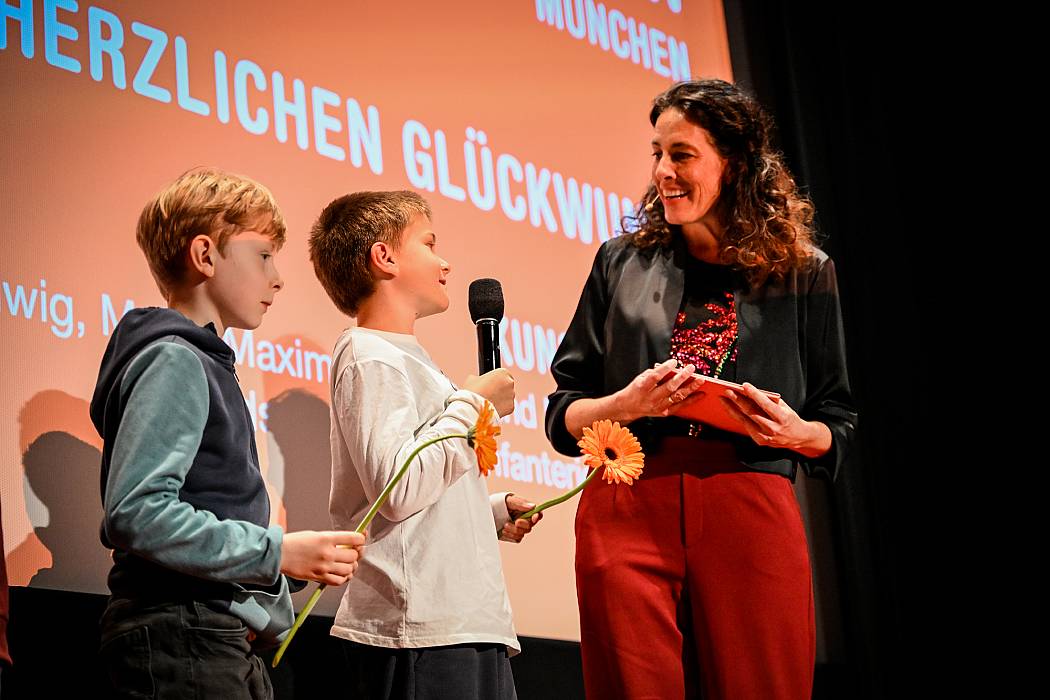
Maya Reichert with two winners of the film competition for young people (c) DOK.fest München / Ronny Heine
This year, the DOK.education team reached 2,241 participants at the cinema. Almost 70 school classes took part in 90-minute workshops at the HFF Munich, the Gasteig HP8, and the Pasinger Fabrik. These workshops are available online to teachers throughout Germany until the end of the school year, and over 7,000 students have already registered. The workshops include three age-appropriate short films, accompanied by school materials and digital learning videos.
Maya Reichert (Head of DOK.education): “At the end of the festival, we evaluate the effectiveness and reach of our work. Behind every number there is a person who has encountered a documentary film. When I see how much is invested in opera or theatre education and networks, I ask myself what would be possible if we were to create access to documentary films just as systematically. Our ‘School of Seeing’, both in cinemas and online, demonstrates this. Even in a culturally diverse city like Munich, we can engage people of all ages with documentary films. This is how we contribute to education and participation, and to building a vibrant, democratic society and the documentary film audience of tomorrow.”
DOK.education also puts young filmmakers in the spotlight. Children and families from all over Bavaria travelled to attend the awards ceremony for the eleventh annual documentary film competition for young people. The HFF Munich’s Audimax was filled to capacity. Five awards, endowed by the Bavarian Teachers’ Association (BLLV), were awarded here. Afterwards, at the reception, young talents, parents, teachers and BLLV President Simone Fleischmann got talking. The jury included Katharina Köster, screenwriter of ‘Pumuckl’, and Elisabeth Wenk, director of the Goldener Spatz children‘s film festival.
Here are the winners of the documentary film competition for young people.
Kathi Seemann (Head of the Documentary Film Competition): “We want to encourage young people to see things in a more nuanced way and to create their own films. The awards ceremony provides a high-profile platform for their perspectives and stories. The 50 submissions we received show that this generation can do far more than just use TikTok. Thanks to our partner BLLV, we can support them with endowed awards and inspire them to create documentaries.”
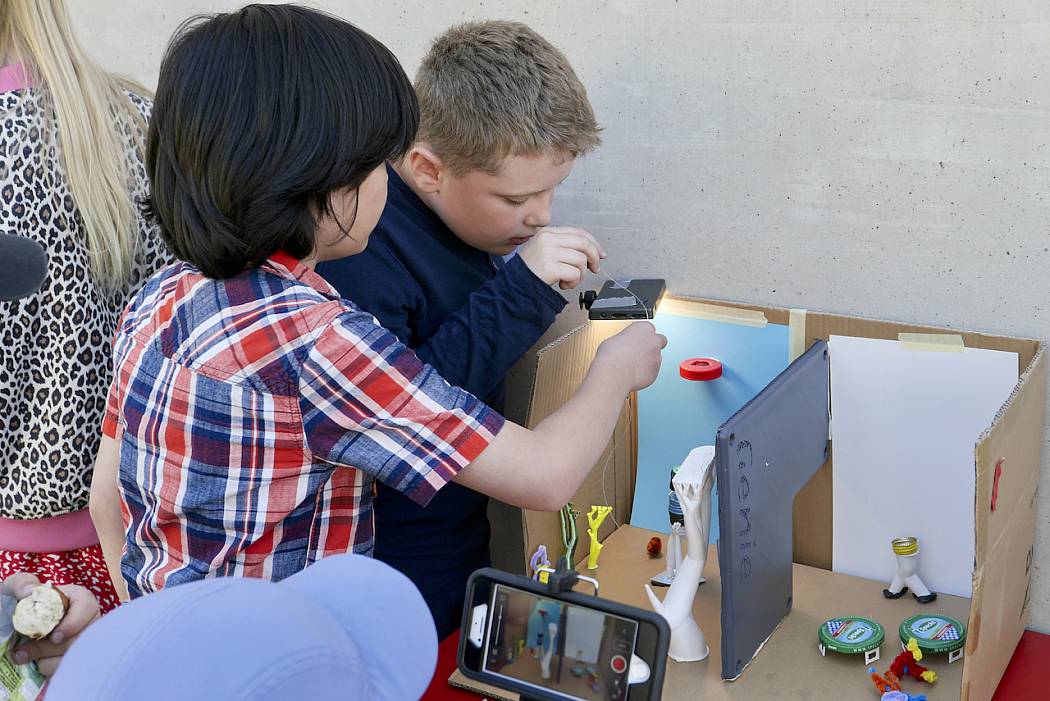
At the animated film workshop (c) DOK.fest München / Emily Schuster-Woldan
A highlight of the supporting programme was the workshop with Julian Jansen, also known as ‘Checker Julian’. With humour and empathy, he taught the youngest participants how to conduct interviews and present themselves confidently in front of a camera or audience. There was also a workshop on AI and film in cooperation with BR, as well as an animated film workshop in cooperation with the mobile bicycle cinema, Ciné Vélo Cité. Based on documentary interviews, children developed their own animated films in the courtyard of the HFF Munich. They presented their short films at an open-air screening and answered questions from the audience.
Mona Klöckner (Head of the Family Programme): “We are fascinated to see what documentary film can achieve beyond artistic creation, particularly with regard to personal development and conveying social values. The film teams in the animated film workshop chose the topics of sustainability, environmental protection, school stress and their own visions for the future. We definitely want to continue this collaboration next year.”